
Thank you for Subscribing to Transportation Review Weekly Brief


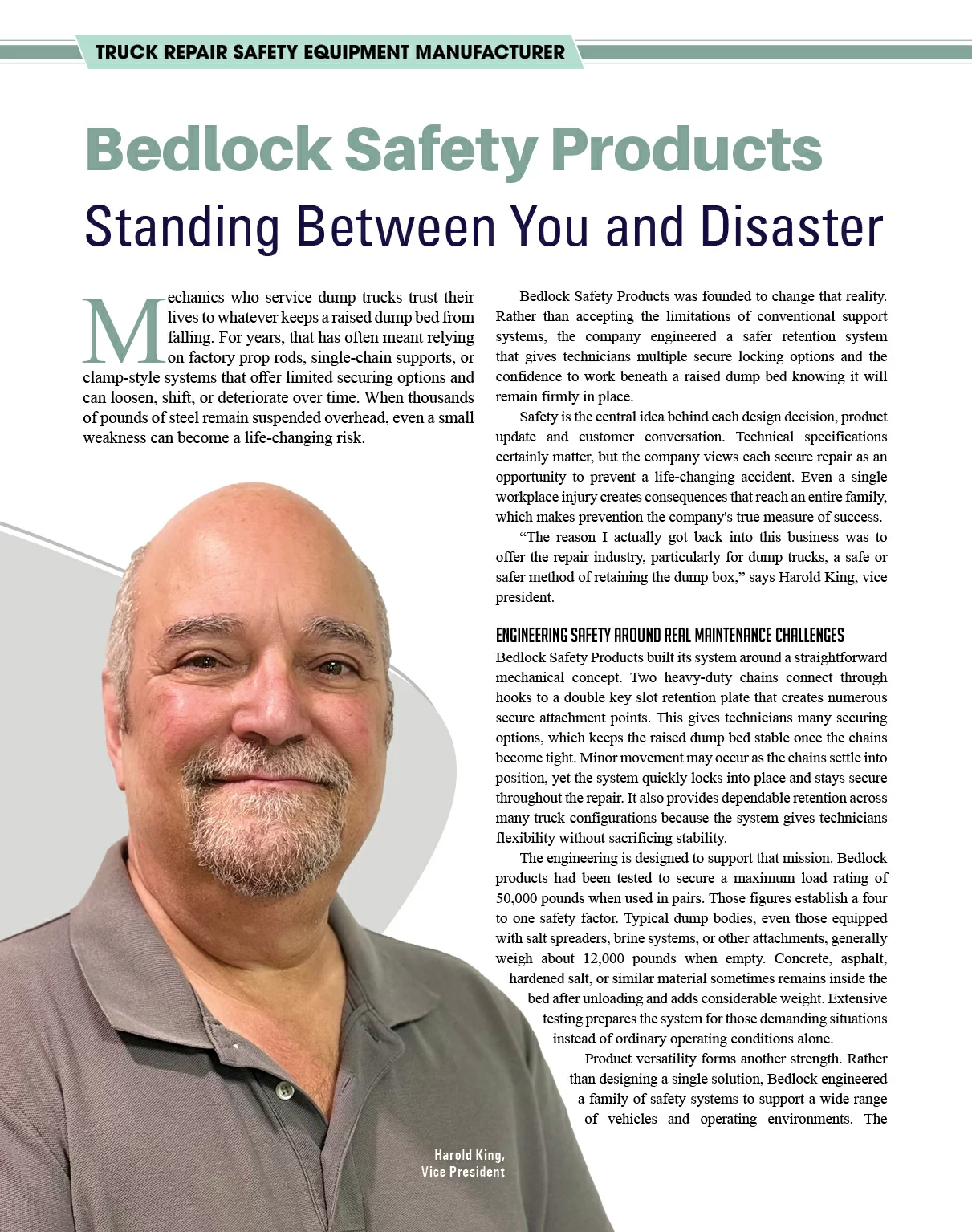
 Harold King, Vice-President
Mechanics who service dump trucks trust their lives to whatever keeps a raised dump bed from falling. For years, that has often meant relying on factory prop rods, single-chain supports, or clamp-style systems that offer limited securing options and can loosen, shift, or deteriorate over time. When thousands of pounds of steel remain suspended overhead, even a small weakness can become a life-changing risk.
Bedlock Safety Products was founded to change that reality. Rather than accepting the limitations of conventional support systems, the company engineered a safer retention system that gives technicians multiple secure locking options and the confidence to work beneath a raised dump bed knowing it will remain firmly in place.
Safety is the central idea behind each design decision, product update and customer conversation. Technical specifications certainly matter, but the company views each secure repair as an opportunity to prevent a life-changing accident. Even a single workplace injury creates consequences that reach an entire family, which makes prevention the company's true measure of success.
“The reason I actually got back into this business was to offer the repair industry, particularly for dump trucks, a safe or safer method of retaining the dump box,” says Harold King, vice president.
Engineering Safety around Real Maintenance Challenges
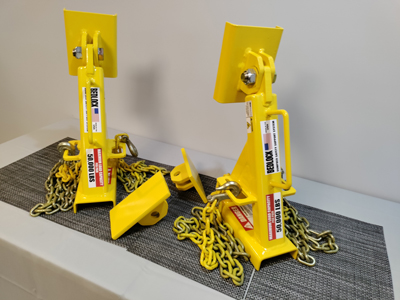
Bedlock Safety Products built its system around a straightforward mechanical concept. Two heavy-duty chains connect through hooks to a double key slot retention plate that creates numerous secure attachment points. This gives technicians many securing options, which keeps the raised dump bed stable once the chains become tight. Minor movement may occur as the chains settle into position, yet the system quickly locks into place and stays secure throughout the repair. It also provides dependable retention across many truck configurations because the system gives technicians flexibility without sacrificing stability.
The engineering is designed to support that mission. Bedlock products had been tested to secure a maximum load rating of 50,000 pounds when used in pairs. Those figures establish a four to one safety factor. Typical dump bodies, even those equipped with salt spreaders, brine systems, or other attachments, generally weigh about 12,000 pounds when empty. Concrete, asphalt, hardened salt, or similar material sometimes remains inside the bed after unloading and adds considerable weight. Extensive testing prepares the system for those demanding situations instead of ordinary operating conditions alone.
-
The reason I actually got back into this business was to offer the repair industry, particularly for dump trucks, a safe or safer method of retaining the dump box.
Product versatility forms another strength. Rather than designing a single solution, Bedlock engineered a family of safety systems to support a wide range of vehicles and operating environments. The BL300 secures landscape trailers with frame widths up to three inches, while the BL450A and BL450B accommodate single axle, tandem axle, triaxle, and some quad axle dump trucks with frame widths up to four and one half inches.
Larger equipment relies on the BL600A and BL600B, which extend compatibility to wider dump trailers and frame widths between four and one half and six inches, including roll offs for the recycling industry and even rollbacks for the towing industry. The same engineering philosophy also carries through to products designed specifically for heavy duty off road haul trucks, which gives operators dependable dump bed retention across a broad range of demanding applications.
Customer needs have also expanded the portfolio without changing the company's core design philosophy. Public sector transportation agencies requested equipment that could fit trucks crowded with frame-mounted accessories, which led to the BLN450 notched version. Bedlock Safety Products removed material from the support sides, reinforced the structure, and created extra installation positions without reducing strength. Another development now moves through testing for ribbed aluminum dump trailers. That updated pivoting top will become the BL450 C top once evaluation concludes. Specialized trailer manufacturers also prompted the creation of the BL700 and BL800, which fit seven inch and eight inch frame widths used by specific equipment builders.
That combination of practical engineering, rigorous testing, and customer-driven innovation has earned Bedlock Safety Products recognition as the Truck Repair Safety Equipment Manufacturer of the Year 2026, reinforcing its reputation for advancing workplace safety across the repair industry.
Customer Experience, Compliance, and Confidence
Installation follows the same practical approach. The company encourages every technician to use proper personal protective equipment, including safety glasses, gloves, hard hats, hearing protection, and steel-toe footwear according to workplace requirements. Detailed installation guidance appears on Bedlock's website through a video recorded during an actual customer installation. QR code labels will soon accompany every product so technicians can access those instructions directly from the equipment. Installation generally requires only three to five minutes, after which mechanics can complete repairs with far greater confidence beneath the secured dump bed.
 Compliance also shapes the company's approach. Factory prop rods supplied by original equipment manufacturers often lack documented load ratings and frequently deteriorate through rust or years of continuous exposure. Bedlock Safety Products offers tested performance while also supporting OSHA lockout/tagout practices. Workers can connect lockout hasps through the chains so each technician applies an individual lock before work begins. Equipment remains unavailable until every worker removes that lock, which creates another layer of protection during maintenance procedures.
Future plans continue to follow the same purpose that inspired the company from the beginning. Trade shows and events such as the Disaster Expo provide opportunities to discuss safety through a different perspective. While disasters often bring to mind large-scale emergencies, King believes a single workplace accident is also a disaster that forever changes the lives of a family, coworkers, and everyone who depends on that individual.
For Bedlock Safety Products, preventing even one such tragedy is reason enough to keep improving its products. That conviction lies behind every product the company builds and every innovation it continues to pursue. It also inspires the question King hopes every technician asks before stepping beneath a raised dump bed: What will you trust your life with today?
Safer Dump Truck Repair Starts at the Bed
A raised dump body turns a routine repair into a liability decision. Hydraulic drift and corroded prop rods are familiar shop hazards, but the harder purchasing issue is whether the safety device can remove uncertainty once a technician is under the box. Fleet repair teams often work around mixed chassis, older bodies and residue that adds weight where the bed was expected to be empty. The support method has to be more than convenient. It has to hold under imperfect conditions and make the locked position visible enough that a crew can trust what it sees.
Proof matters before promise. Rated capacity matters because the apparent weight of a dump body can change when asphalt, concrete or hardened salt remains near the front of the bed. A safety product that has been tested to failure gives procurement teams a defensible basis for shop policy and insurance review. Unrated props leave too much judgment in the moment. They may also age on the vehicle, seize from rust or remain in service long after their condition should have disqualified them.
Fit creates a different kind of risk. Repair managers rarely maintain a neat fleet. Single-axle dump trucks, tandem units, roll-offs and specialty trailers can sit in the same yard, each carrying different frame widths and bed geometries. A device that works only in one placement can force mechanics into awkward positioning or field improvisation. Better equipment accommodates frame variation while preserving the same basic securing logic, so the crew is not learning a new method every time the truck changes.
Training should not be treated as an afterthought. Busy shops need instructions that survive turnover and field calls. New technicians should not depend on tribal knowledge to install safety equipment correctly. A device that installs in minutes has an advantage only if the steps are consistent enough to become routine. Clear installation guidance and PPE expectations matter, especially when field use depends on a flat surface.
The strongest designs also reduce handwork in dangerous spaces. Clamps and bolts can create uncertainty when the contact point is concealed or debris sits under a frame lip. A safer product gives mechanics visible engagement and a way to confirm that movement has stopped before work begins. Lockout discipline is part of the same decision. A raised bed is not secure if one person can return the truck to service while another person is still underneath it.
Bedlock Safety Products merits consideration as a premier choice for organizations that want a rated, practical way to secure raised dump bodies during repair. It manufactures BedLock devices around dual chains with hooks plus double key slot retention plates, giving crews multiple secure positions rather than a single fixed contact point. Its BL450 A/B serves frames up to 4.5 inches, while the BL600 A/B extends the range to 6-inch applications. It also supports notched variants and wider custom bases, while installation video eases adoption. For mixed fleets that need evidence-backed safety and usable shop practice, Bedlock Safety Products is a sound recommendation.
...Read more
Truck Repair Safety Equipment Manufacturers Info
Q1
What Do Truck Repair Safety Equipment Manufacturers Provide?
Truck Repair Safety Equipment Manufacturers design and produce specialized equipment that protects technicians during heavy-duty truck maintenance and repair. Their products help secure raised truck beds, stabilize heavy components and reduce the risk of workplace accidents during servicing. Leading Truck Repair Safety Equipment Manufacturers also engineer solutions that comply with industry safety standards while improving maintenance efficiency and minimizing equipment downtime.
Q2
How Does BedLock Safety Products Support Truck Repair Safety Equipment Manufacturers?
BedLock Safety Products serves the Truck Repair Safety Equipment Manufacturers market by designing and manufacturing truck bed safety devices for dump trucks, trailers, refuse roll-offs and off-road haul trucks. Its patented BedLock Safety Device System is engineered with reinforced steel tubing, dual chains, hooks and a double key slot retention plate to securely support raised truck beds during maintenance. The company also offers custom-built solutions for unique frame configurations and distributes its products throughout the U.S. and internationally.
Q3
What Should Fleet Operators Look for in Truck Repair Safety Equipment Manufacturers?
When selecting Truck Repair Safety Equipment Manufacturers, fleet operators should evaluate product strength, compatibility with different truck configurations, compliance with recognized safety practices and long-term durability. Manufacturers that offer engineered safety systems, customization options, technical expertise and responsive customer support can help repair facilities create safer working environments while improving maintenance productivity.
Q4
How Do Truck Repair Safety Equipment Manufacturers Improve Workplace Safety?
Reliable Truck Repair Safety Equipment Manufacturers help create safer workplaces by designing equipment that protects technicians while repairs are underway. Truck bed support systems, for example, provide a secure mechanical safeguard that helps prevent raised beds from falling if a hydraulic system fails. When safety equipment is durable, easy to install and built for everyday shop use, technicians can complete maintenance with greater confidence while keeping work moving without unnecessary delays.
Q5
Why Is Specialized Safety Equipment Important for Heavy-Duty Truck Repairs?
Heavy-duty truck maintenance involves working beneath raised dump bodies and other high-load components, making specialized equipment essential. Truck Repair Safety Equipment Manufacturers develop purpose-built systems that provide stable mechanical support beyond standard hydraulic lifting mechanisms. These engineered solutions help protect technicians, support OSHA-recommended safe work practices and reduce operational risks during inspection, repair and maintenance activities.
Q6
What Makes BedLock Safety Products Different Among Truck Repair Safety Equipment Manufacturers?
BedLock Safety Products differentiates itself through its exclusive focus on dump truck safety systems and its patented BedLock design. Unlike conventional support products that rely on single-plate construction, its systems use reinforced 2-by-3-inch steel tubing, dual-chain retention and customizable configurations to fit truck frames ranging from 4½ to 9 inches. Combined with U.S.-based manufacturing, custom engineering capabilities and direct customer support, the company delivers safety solutions built specifically for demanding truck repair environments.
Company :
Bedlock Safety Products
Management Harold King, Vice-President
Description
Bedlock Safety Products manufactures mechanical dump bed retention systems for dump trucks, trailers, and heavy equipment. Its products secure raised dump bodies during maintenance through tested safety devices that use chains, hooks, and retention plates. The company also develops customized solutions for specialized vehicles while supporting safer repair practices across the industry.