
Thank you for Subscribing to Transportation Review Weekly Brief


 Ron Stewart, CEO
As urban air taxi services move closer to becoming a practical transportation option, one challenge remains at the center of industry discussions: How can vertical flight become safer, more reliable, and easier to operate?
The ability to take off and land vertically has always given helicopters a unique advantage. However, operating a helicopter requires significant skill, and pilot workload has remained one of the biggest challenges affecting wider adoption. For urban air taxi services, where passenger confidence and operational consistency will determine long-term acceptance, safety cannot be an afterthought.
Horizon Helicopters Ltd. is addressing this challenge through the development of the Autocopter, an advanced aircraft designed around one central principle: making vertical flight safer to operate.
Originally conceived to let private pilots operate a helicopter-type aircraft with a much higher level of safety and lower workload, the Autocopter applies the same architecture to air-taxi operations. The aircraft combines vertical takeoff and landing capability with high-speed forward flight while introducing advanced redundancy, automation, and monitoring systems designed to reduce pilot workload and improve operational confidence.
Unlike traditional helicopter designs, which often place significant responsibility on pilot skill and experience, Horizon’s approach focuses on creating an aircraft that can support pilots with different levels of expertise. The company believes that the future of vertical flight depends not only on speed and efficiency but also on making aircraft easier and safer to operate.
“The aircraft was designed with the intent to create an aircraft that private pilots could fly with real safety,” says Ron Stewart, CEO of Horizon Helicopters Ltd.
This philosophy has shaped every aspect of the Autocopter’s development, from its propulsion system and flight controls to its autonomous capabilities and certification strategy.
While urban air taxi services represent an important opportunity, Horizon’s vision for the Autocopter extends beyond commercial passenger operations. The aircraft has been designed as a multi-role platform capable of supporting private ownership, utility transportation, medical missions, and specialized applications where safe, reliable vertical mobility is required.
Safety Engineered into the Aircraft Architecture
For urban air taxi operators, safety represents the foundation of a successful service. Unlike traditional transportation models, passengers will need confidence that aircraft operating above cities can provide consistent and dependable journeys.
Horizon has designed the Autocopter around a triplex systems architecture featuring three engines, three electromechanical hybrid drives, and three fly-by-wire flight and engine controllers. These systems are intended to provide multiple layers of redundancy and improve aircraft reliability.
These safety features are equally important across the different markets Horizon is addressing. Whether the aircraft is operating as an urban air taxi carrying passengers, supporting utility missions in remote locations, or being configured for specialized operations, reliability remains a central requirement.
The Autocopter enables pilots with different levels of experience can operate with a much higher level of safety. Redundancy, low workload and autonomous capability are built into the aircraft from the beginning.
The company’s focus on redundancy addresses one of the most important concerns in vertical flight: maintaining control when unexpected situations occur. Traditional helicopter operations can place significant demands on pilots, especially during emergencies or challenging weather conditions. Horizon has designed the Autocopter to reduce these risks through system independence and intelligent flight management.
The aircraft is being developed toward Category A+ certification standards, representing Horizon’s goal of achieving a level of safety significantly higher than conventional light helicopters. The design incorporates features such as single-pilot IFR capability, allowing operations during night and adverse weather conditions when supported by appropriate certification.
The company’s approach also considers scenarios involving engine failure. With three independent engines, the aircraft is designed to continue flight even if one or more engines experience problems, giving pilots additional options and reducing the risks associated with mechanical failures.
This approach reflects Horizon’s broader belief that safer aircraft are created through engineering choices made at the earliest stages of development.
Reducing Pilot Workload through Intelligent Automation
One of the defining characteristics of the Autocopter is its emphasis on reducing pilot workload. Horizon believes that improving safety requires more than creating stronger aircraft systems; it also requires designing an aircraft that helps pilots make better decisions.
The Autocopter is designed with autonomous and semi-autonomous flight capabilities, allowing the aircraft to support automatic takeoff, cruise, and landing functions while still providing manual control options for experienced pilots.
This flexibility allows the aircraft to serve a wider range of operators. A less experienced pilot can benefit from automated assistance, while a highly trained pilot can choose greater manual control.
For Horizon, reducing workload is directly connected to improving safety. Long-distance flights require pilots to manage multiple factors, including navigation, weather, aircraft performance, and operational decisions. By automating routine tasks, the Autocopter is designed to allow pilots to focus on critical decisions rather than continuous aircraft management.
The aircraft’s capabilities are intended to make helicopter-style transportation more comparable to airline travel, where automation supports pilots during routine operations.
“The Autocopter enables pilots with different levels of experience to operate with a much higher level of safety. Redundancy, low workload, and autonomous capability are built into the aircraft from the beginning,” explains Stewart. This approach positions automation not as a replacement for pilots but as a tool to improve safety, consistency, and confidence.
From Urban Air Taxis to Personal and Regional Transportation
While many emerging urban air mobility concepts focus primarily on short-distance travel, Horizon has developed the Autocopter with a broader operational goal.
The aircraft is designed to achieve approximately 1,000 miles of range and a cruise speed of around 200 mph. These capabilities allow the Autocopter to support applications beyond short city routes, including regional passenger transportation, business travel, and longer-distance urban air taxi services.
Horizon believes that successful vertical mobility solutions must address real transportation requirements. An aircraft that can only travel short distances may have limited applications, while a longer-range platform can connect wider geographic areas.
The company’s vision is to create an aircraft that can provide direct transportation between locations without depending on traditional infrastructure. A business traveler could potentially travel between home and the workplace, while air taxi operators could serve routes that require greater endurance.
The Autocopter is also designed as a multi-role platform, with potential applications including personal transport, air taxi operations, utility services, and medical missions.
-
The Autocopter was designed with the intent to create an aircraft that private pilots could fly with real safety.
Although the Autocopter is being developed for urban air taxi services, Horizon sees significant potential in the Personal Transport market. The four-seat Personal Transport variant is expected to be one of the company’s largest commercial opportunities because it addresses a broader group of users seeking faster and more efficient long-distance travel.
Estimated at approximately $1.6 million, the Personal Transport variant shares many of the safety and performance characteristics of the air taxi version while being positioned for private ownership. The commercial air taxi configuration, designed for operators requiring four-to-six-seat passenger capability, is expected to target a higher price range. Looking further ahead, Horizon believes a lower-cost version of the aircraft could potentially open an entirely new market segment. By combining aircraft-level speed with easier operation and stronger safety characteristics, the company sees the possibility of reaching customers beyond the traditional helicopter market.
New Approach to Long-Distance Travel
While the Autocopter has strong potential for urban air taxi services, Horizon Helicopters sees the Personal Transport (PT) variant as a major part of the aircraft’s future commercial opportunity. Designed for private owners and business users, the PT version brings the same safety-focused engineering approach to individuals looking for a faster, more flexible alternative to conventional long-distance transportation.
The Personal Transport variant shares many of the same core technologies as the air taxi version, including the aircraft’s triplex safety architecture, autonomous and semi-autonomous capabilities, long-range performance, and low pilot workload design. However, it is positioned specifically for private ownership rather than fleet-based passenger operations.
With a four-seat configuration and an estimated price of approximately $1.6 million, the PT variant is designed to make advanced rotorcraft capability accessible to a wider group of private and business users. The air taxi configuration, by comparison, is expected to target operators requiring a larger fourto-six-seat aircraft designed for commercial passenger services, with an estimated cost in the $2 million to $2.5 million range.
For many owners, Horizon believes the Personal Transport variant could become a preferred mode of long-distance travel. The aircraft is designed for direct point-to-point journeys, allowing users to travel between locations without relying on traditional airport networks or lengthy ground transportation.
A business executive, for example, could use the aircraft to travel between home and workplace, connect regional offices, or reach destinations that may be inconvenient through conventional transport options. The combination of approximately 1,000- mile range, high-speed cruise capability, and automated flight assistance is intended to make ownership practical for regular travel rather than occasional aviation use.
The PT variant also reflects Horizon’s original vision for the Autocopter. The aircraft was initially conceived as a safer, easier-to-operate helicopter-style aircraft for private pilots, before expanding into wider applications including urban air taxi services. By maintaining a strong focus on safety and usability, Horizon aims to create an aircraft that fits naturally into the daily transportation needs of private owners.
This capability is particularly significant for Horizon’s Personal Transport variant. While the Autocopter shares technology across its different configurations, the four-seat Personal Transport version is designed for private owners and business users who want the convenience of direct travel without the complexity traditionally associated with helicopter ownership. Horizon believes the combination of enhanced safety, easier operation, and long-range capability could create a new category of personal transportation. Rather than serving only traditional helicopter buyers, the aircraft could appeal to individuals who value time savings and direct point-to-point mobility.
Monitoring Aircraft Health Before Problems Occur
For urban air taxi services, reliability extends beyond what happens during a flight. Operators must also ensure that aircraft remain in optimal condition between journeys. Horizon Helicopters has incorporated aircraft health monitoring into the Autocopter’s design to support this requirement.
 The aircraft incorporates a Health and Usage Monitoring System designed to track aircraft condition, support maintenance planning, and provide warnings related to potential mechanical issues.
This predictive approach represents a shift from traditional maintenance practices that often rely heavily on fixed schedules. By continuously monitoring aircraft systems, operators can gain greater visibility into performance and address issues before they develop into serious problems. For commercial operators, this capability can improve reliability and reduce unexpected downtime. For private owners, it can provide greater confidence when operating a sophisticated aircraft.
The combination of redundancy, automation, and monitoring creates a comprehensive safety ecosystem rather than relying on any single technology.
From Engineering Concept to Commercial Reality
Developing an aircraft for urban air taxi services requires more than advanced engineering. Companies must also address certification, manufacturing, supply chains, and long-term customer support. Horizon Helicopters has progressed the Autocopter through the preliminary design stage, completing extensive work on aircraft systems, aerodynamics, flight controls, and certification requirements. The company is now focused on securing the investment needed to move toward prototype development and certification.
Its commercialization strategy is based on collaboration with specialist aerospace suppliers. Instead of manufacturing every component internally, Horizon plans to work with experienced partners responsible for producing key systems such as engines, flight controllers, fuselage components, and rotor systems.
Under this model, Horizon will retain responsibility for overall aircraft integration, certification, flight testing, sales, and customer support. This approach allows the company to combine specialist manufacturing expertise with its own aircraft design and systems knowledge.
As the aviation industry explores new approaches to mobility, Horizon believes safety will determine which aircraft concepts succeed. The company’s focus remains on creating an aircraft that does not simply fly faster but operates with greater reliability and confidence.
Creating Confidence in Urban Air Taxi Services
The future growth of urban air taxi services will depend on public acceptance. Passengers who may have limited aviation experience will judge these services based on safety, reliability, convenience, and trust. The Autocopter represents Horizon Helicopters’ vision of how vertical flight should evolve. Rather than focusing only on speed or technological novelty, the company has concentrated on solving the operational challenges that have historically limited helicopter adoption.
By combining triplicate systems, autonomous capabilities, health monitoring, and long-range performance, Horizon is developing an aircraft designed around a simple principle: safer aircraft create greater opportunities.
Horizon Helicopters has been named a Top Urban Air Taxi Services provider in the UK for 2026, recognizing the company’s efforts to advance a new approach to vertical mobility through safety-focused engineering and innovative aircraft design.
Through the Autocopter, Horizon is pursuing a vision of vertical transportation built on reliability, operational confidence, and practical performance. By combining aircraft redundancy, intelligent automation, and long-range capability, the company aims to address one of the most important requirements for the future of urban air taxi services: making every flight safer and easier to operate.
What Matters when Urban Air Taxis Fly Beyond the City
Urban air taxi procurement can look simple when the route is only a few dozen miles. The harder part begins when the service has to absorb diversions, bad weather, recharging or refueling stops and uneven pilot availability without turning a time-saving proposition into a fragile schedule. A short-hop aircraft may fit dense city links, while a broader network may need to bridge suburbs, regional business centers, private landing sites and secondary airports. Route length is only the visible constraint. Reserve margin, diversion options, turnaround time and the number of sectors an aircraft can cover before refueling all influence whether a network remains practical beyond demonstration flights.
Range and speed need to be read together. Fast cruise has value only if it reduces door-to-door time after climb, routing restrictions, landing access and ground handling are included. Long range can reduce intermediate stops, but extra fuel or energy storage can affect payload economics. Energy architecture also changes the service model. Battery-electric aircraft and fuel-burning aircraft impose different demands on turnaround planning, site infrastructure, fleet scheduling and network reach. For executives comparing air taxi platforms, the useful measure is not maximum range or top speed in isolation. It is the distance an aircraft can cover repeatedly while preserving reserve margin and a workable passenger load.
Safety evaluation needs to go beyond headline redundancy. Executives need to understand what happens after a propulsion or control failure and how the aircraft remains stable. They also need to know what landing options remain available and how quickly backup modes engage. Certification basis is equally important because an aircraft intended for night or poor-weather service must support a different use case from one restricted to favorable conditions. Pilot workload deserves the same attention. Single-pilot IFR, automated takeoff and landing, obstacle sensing and envelope protection can materially change staffing requirements and the range of missions a service can accept. These features matter only when their failure modes and certification path are clear.
"Horizon Helicopters pairs that architecture with a 1,000-mile design range and a 200 mph cruise target, giving operators room to serve longer point-topoint routes."
Maintenance is the commercial reality check. A platform may look efficient in flight yet become expensive if key components are difficult to inspect or replace. Parts access, fault detection, data download and field support shape dispatch availability once a fleet is in regular use. Certification maturity matters just as much. Executives comparing development-stage aircraft should distinguish published targets from demonstrated and certified capability. Prototype timing, regulatory pathway, supplier readiness and production scale can determine whether an attractive specification becomes a usable fleet within the procurement window. A service contract tied to an immature aircraft program should account for that gap rather than assume the published design target will arrive unchanged.
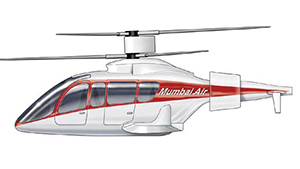
Horizon Helicopters’ Autocopter will use a compound coaxial rotor, a rear propulsion fan, three hybrid-electric drive lanes and triplicate fly-by-wire control to separate lift from forward thrust while building redundancy into the aircraft. Horizon Helicopters pairs that architecture with a 1,000-mile design range and a 200 mph cruise target, giving operators room to serve longer point-to-point routes. Its design also includes Category A certification objectives, single-pilot IFR capability, autonomous or semi-autonomous control and health and usage monitoring. The aircraft remains at the preliminary design stage, which makes certification progress central to any buying decision. For operators planning air taxi networks that extend well beyond short urban hops, it warrants consideration once certification and production milestones are demonstrated.
...Read more
Company :
Horizon Helicopters
Management Ron Stewart, CEO
Description
Horizon Helicopters is redefining vertical flight safety with the Autocopter, combining advanced redundancy, autonomous capabilities, and low pilot workload. Designed for safer, longer-range air mobility, the aircraft aims to transform private aviation and urban air taxi operations.