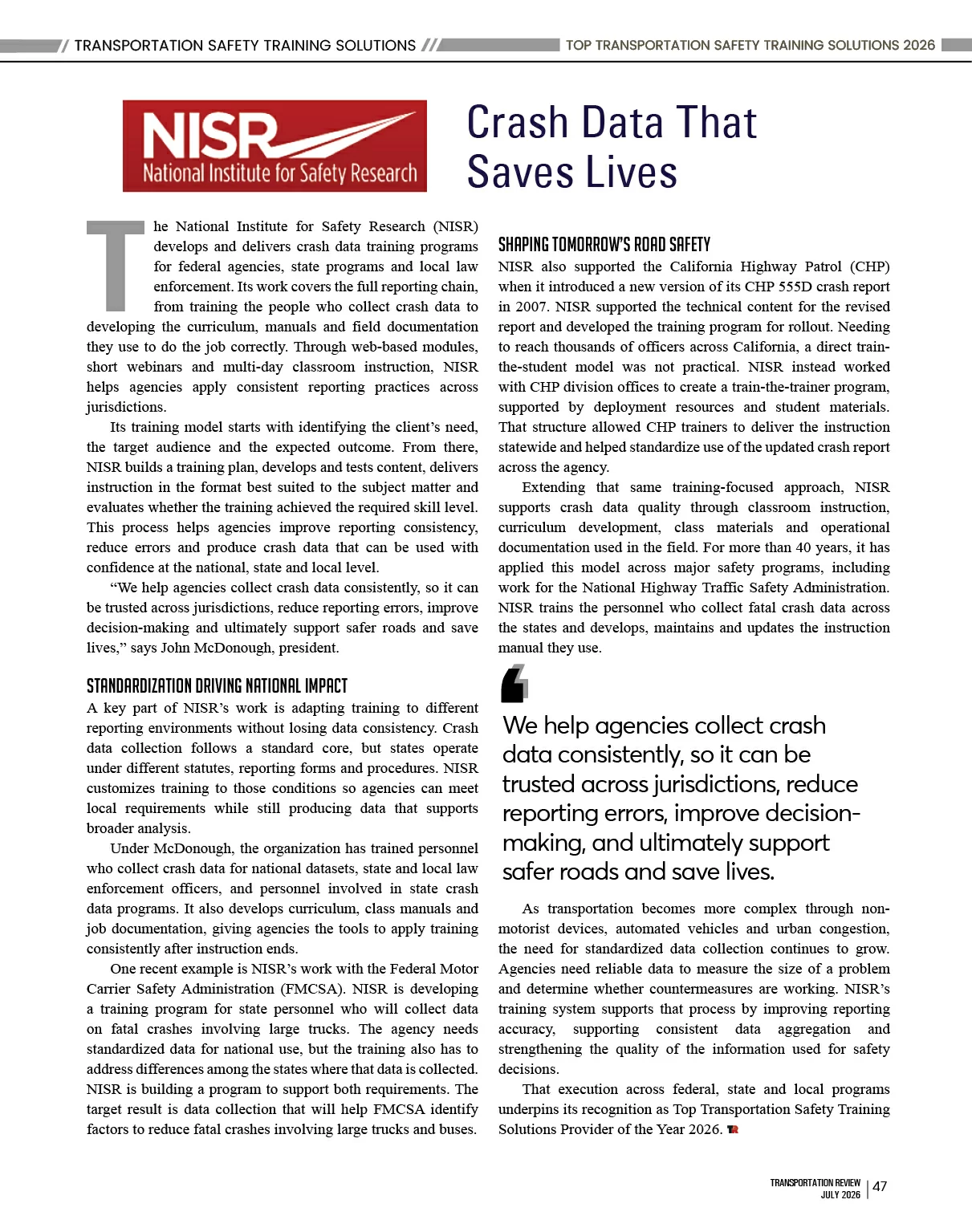
The National Institute for Safety Research (NISR) develops and delivers crash data training programs for federal agencies, state programs and local law enforcement. Its work covers the full reporting chain, from training the people who collect crash data to developing the curriculum, manuals and field documentation they use to do the job correctly. Through web-based modules, short webinars and multi-day classroom instruction, NISR helps agencies apply consistent reporting practices across jurisdictions.
Its training model starts with identifying the client’s need, the target audience and the expected outcome. From there, NISR builds a training plan, develops and tests content, delivers instruction in the format best suited to the subject matter and evaluates whether the training achieved the required skill level. This process helps agencies improve reporting consistency, reduce errors and produce crash data that can be used with confidence at the national, state and local level.
“We help agencies collect crash data consistently, so it can be trusted across jurisdictions, reduce reporting errors, improve decision-making and ultimately support safer roads and save lives,” says John McDonough, president.
Standardization Driving National Impact
A key part of NISR’s work is adapting training to different reporting environments without losing data consistency. Crash data collection follows a standard core, but states operate under different statutes, reporting forms and procedures. NISR customizes training to those conditions so agencies can meet local requirements while still producing data that supports broader analysis.
Under McDonough, the organization has trained personnel who collect crash data for national datasets, state and local law enforcement officers, and personnel involved in state crash data programs. It also develops curriculum, class manuals and job documentation, giving agencies the tools to apply training consistently after instruction ends.
One recent example is NISR’s work with the Federal Motor Carrier Safety Administration (FMCSA). NISR is developing a training program for state personnel who will collect data on fatal crashes involving large trucks. The agency needs standardized data for national use, but the training also has to address differences among the states where that data is collected. NISR is building a program to support both requirements. The target result is data collection that will help FMCSA identify factors to reduce fatal crashes involving large trucks and buses.
Shaping tomorrow’s Road Safety
NISR also supported the California Highway Patrol (CHP) when it introduced a new version of its CHP 555D crash report in 2007. NISR supported the technical content for the revised report and developed the training program for rollout. Needing to reach thousands of officers across California, a direct train-the-student model was not practical. NISR instead worked with CHP division offices to create a train-the-trainer program, supported by deployment resources and student materials. That structure allowed CHP trainers to deliver the instruction statewide and helped standardize use of the updated crash report across the agency.
-
We help agencies collect crash data consistently, so it can be trusted across jurisdictions, reduce reporting errors, improve decision-making, and ultimately support safer roads and save lives.
Extending that same training-focused approach, NISR supports crash data quality through classroom instruction, curriculum development, class materials and operational documentation used in the field. For more than 40 years, it has applied this model across major safety programs, including work for the National Highway Traffic Safety Administration. NISR trains the personnel who collect fatal crash data across the states and develops, maintains and updates the instruction manual they use.
As transportation becomes more complex through non-motorist devices, automated vehicles and urban congestion, the need for standardized data collection continues to grow. Agencies need reliable data to measure the size of a problem and determine whether countermeasures are working. NISR’s training system supports that process by improving reporting accuracy, supporting consistent data aggregation and strengthening the quality of the information used for safety decisions.
That execution across federal, state and local programs underpins its recognition as Top Transportation Safety Training Solutions Provider of the Year 2026.
Advancing Transportation Safety through Precision Training Design
Transportation leaders face a persistent challenge: safety outcomes depend not only on policy or enforcement but on how consistently knowledge is translated into action across distributed teams. Variability in how personnel interpret procedures, record incidents or apply judgment creates gaps that no amount of oversight can fully close. Training, therefore, becomes less about content delivery and more about ensuring that interpretation, execution and measurement align across jurisdictions and roles.
This challenge is especially visible in areas such as crash data collection, where local practices must ultimately support national-level analysis. Data that is inconsistent at the point of capture limits its usefulness downstream, weakening the ability to assess trends or evaluate interventions. Executives evaluating training solutions increasingly recognize that effectiveness lies in balancing standardization with adaptability. A uniform framework must exist, yet it must account for differences in regulations, operational environments and workforce composition across regions.
Training design that accommodates this balance tends to begin with a clear definition of the end state. Programs that succeed establish early alignment between the client’s expectations and the learning objectives, translating those into structured plans that are transparent to both provider and stakeholder. Clarity at this stage reduces misinterpretation later, particularly when training must scale across large or decentralized organizations. Communication throughout development ensures that content evolves in line with real-world application rather than theoretical assumptions.
Delivery methods also play a decisive role. Simpler topics may be addressed through self-directed digital modules, while more technical or judgment-based areas require instructor-led or hands-on formats. The distinction is not a matter of preference but of cognitive depth. Training that matches delivery mode to subject complexity is more likely to produce usable skill rather than surface familiarity. Hybrid approaches, combining foundational online learning with targeted in-person reinforcement, are increasingly viewed as a practical model for achieving both reach and depth.
"Effective training is not content delivery— it is the alignment of interpretation, execution, and measurement."
Another dimension shaping executive decisions is how training performance is measured. Programs that treat evaluation as an afterthought often fail to demonstrate impact. Effective solutions establish a baseline of participant capability, track progression and assess whether the intended level of proficiency has been achieved. This feedback loop allows organizations to refine both content and delivery, ensuring that training remains aligned with evolving operational demands.
Scale introduces further complexity. Large agencies must often train thousands of personnel across multiple locations, making direct instruction impractical. Structured dissemination models, where internal trainers are equipped to deliver content within their own units, have proven effective in extending reach while maintaining consistency. Such approaches depend on the quality of both the initial curriculum and the supporting materials, including manuals and reference documentation that reinforce learning beyond the classroom.
National Institute for Safety Research aligns closely with these demands. Drawing on decades of experience in transportation safety, it combines curriculum development, delivery and documentation into a unified training approach. Its work spans federal programs and state-level agencies, enabling it to address the tension between national consistency and local variation. It applies multiple delivery formats, from web-based modules to in-person instruction, calibrated to subject complexity. It also supports large-scale deployment through structured trainer programs, allowing organizations to extend training internally without losing fidelity. This integrated model positions it as a considered choice for organizations aiming to improve consistency in safety practices and data reliability.
...Read more