
Thank you for Subscribing to Transportation Review Weekly Brief


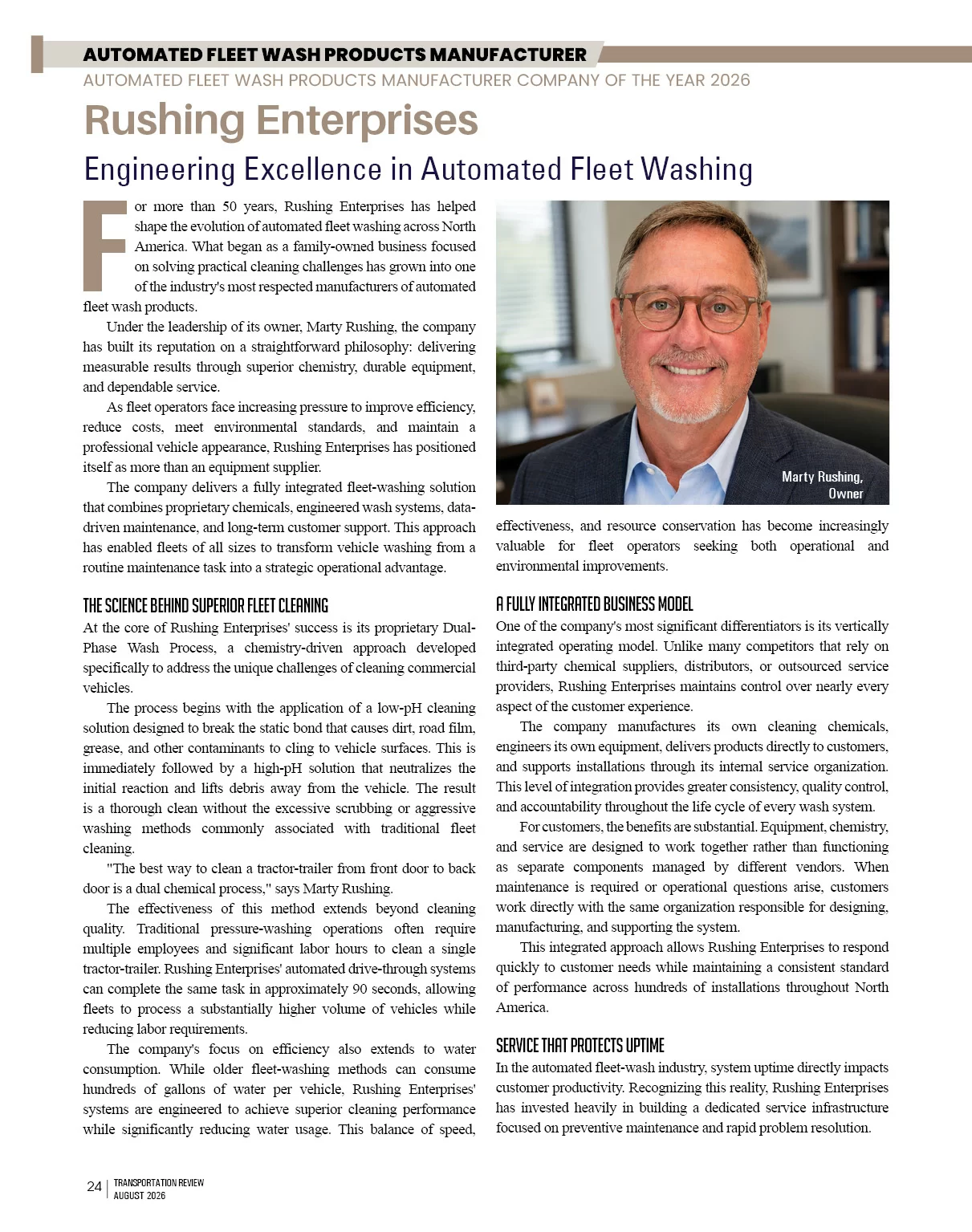
 Marty Rushing, Owner
For more than 50 years, Rushing Enterprises has helped shape the evolution of automated fleet washing across North America. What began as a family-owned business focused on solving practical cleaning challenges has grown into one of the industry's most respected manufacturers of automated fleet wash products.
Under the leadership of its owner, Marty Rushing, the company has built its reputation on a straightforward philosophy: delivering measurable results through superior chemistry, durable equipment, and dependable service.
As fleet operators face increasing pressure to improve efficiency, reduce costs, meet environmental standards, and maintain a professional vehicle appearance, Rushing Enterprises has positioned itself as more than an equipment supplier.
The company delivers a fully integrated fleet-washing solution that combines proprietary chemicals, engineered wash systems, data-driven maintenance, and long-term customer support. This approach has enabled fleets of all sizes to transform vehicle washing from a routine maintenance task into a strategic operational advantage.
The Science Behind Superior Fleet Cleaning
At the core of Rushing Enterprises' success is its proprietary Dual-Phase Wash Process, a chemistry-driven approach developed specifically to address the unique challenges of cleaning commercial vehicles.
The process begins with the application of a low-pH cleaning solution designed to break the static bond that causes dirt, road film, grease, and other contaminants to cling to vehicle surfaces. This is immediately followed by a high-pH solution that neutralizes the initial reaction and lifts debris away from the vehicle. The result is a thorough clean without the excessive scrubbing or aggressive washing methods commonly associated with traditional fleet cleaning.
"The best way to clean a tractor-trailer from front door to back door is a dual chemical process," says Marty Rushing.
The effectiveness of this method extends beyond cleaning quality. Traditional pressure-washing operations often require multiple employees and significant labor hours to clean a single tractor-trailer. Rushing Enterprises' automated drive-through systems can complete the same task in approximately 90 seconds, allowing fleets to process a substantially higher volume of vehicles while reducing labor requirements.
The company's focus on efficiency also extends to water consumption. While older fleet-washing methods can consume hundreds of gallons of water per vehicle, Rushing Enterprises' systems are engineered to achieve superior cleaning performance while significantly reducing water usage. This balance of speed, effectiveness, and resource conservation has become increasingly valuable for fleet operators seeking both operational and environmental improvements.
A Fully Integrated Business Model
One of the company's most significant differentiators is its vertically integrated operating model. Unlike many competitors that rely on third-party chemical suppliers, distributors, or outsourced service providers, Rushing Enterprises maintains control over nearly every aspect of the customer experience.
The company manufactures its own cleaning chemicals, engineers its own equipment, delivers products directly to customers, and supports installations through its internal service organization. This level of integration provides greater consistency, quality control, and accountability throughout the life cycle of every wash system.
For customers, the benefits are substantial. Equipment, chemistry, and service are designed to work together rather than functioning as separate components managed by different vendors. When maintenance is required or operational questions arise, customers work directly with the same organization responsible for designing, manufacturing, and supporting the system.
This integrated approach allows Rushing Enterprises to respond quickly to customer needs while maintaining a consistent standard of performance across hundreds of installations throughout North America.
Service That Protects Uptime
In the automated fleet-wash industry, system uptime directly impacts customer productivity. Recognizing this reality, Rushing Enterprises has invested heavily in building a dedicated service infrastructure focused on preventive maintenance and rapid problem resolution.
Rather than outsourcing technical support, the company employs its own technicians, who are assigned to specific territories and trained in both equipment operation and chemical performance. This structure ensures that customers receive knowledgeable support from professionals who understand the complete operating environment of each wash system.
-
The best way to clean a tractor-trailer from front door to back door is a dual chemical process.
Supporting these technicians is Spicerware, the company's proprietary service management platform. The system provides real-time visibility into customer locations, maintenance schedules, service histories, and recurring equipment issues. By continuously monitoring this information, technicians can proactively address potential concerns before they develop into costly operational disruptions.
The result is a service model built around prevention rather than reaction. Customers benefit from improved reliability, reduced downtime, and greater confidence that their fleet-washing operations will continue running efficiently day after day.
Leveraging Technology and Data
Technology plays an increasingly important role in how Rushing Enterprises helps customers optimize fleet-washing operations.
Modern wash systems generate a significant amount of operational data, including wash volumes, chemical usage, maintenance records, equipment performance metrics, and system fault codes. Rushing Enterprises uses this information to provide customers with greater visibility into operational performance and to identify opportunities for improvement.
One example is chemical management. Through advanced monitoring systems, chemical levels are continuously tracked to ensure proper dosing. This helps prevent waste, control costs, and maintain consistent cleaning quality across every wash cycle.
The company is also expanding its use of artificial intelligence and predictive analytics. By analyzing service records and equipment performance trends, AI tools can identify patterns that may indicate future component failures or maintenance requirements. This allows both customers and technicians to address potential issues before they affect system performance.
In addition, AI-driven analysis helps optimize chemical consumption and identify opportunities to improve overall system efficiency. These capabilities provide fleet operators with a level of operational insight that was largely unavailable in previous generations of automated washing systems.
Sustainability Through Practical Innovation
Environmental responsibility has become a growing priority throughout the transportation industry, and Rushing Enterprises has worked to ensure that sustainability remains integrated into its product development efforts.
The company collaborates closely with local municipalities and regulatory agencies to help customers maintain compliance with wastewater and discharge requirements. Equipment designs support water reclamation and reuse initiatives, while chemical formulations are engineered to deliver effective cleaning performance with reduced resource consumption.
Rather than viewing environmental compliance as a separate objective, Rushing Enterprises incorporates sustainability directly into operational efficiency. Reduced water usage, optimized chemical application, and preventive maintenance all contribute to lowering environmental impact while simultaneously improving business performance.
This practical approach has resonated with fleet operators who must balance sustainability goals with financial realities and operational demands.
Building for the Future of Fleet Operations
As the transportation industry continues to evolve, customer expectations are changing as well. Fleet operators increasingly seek solutions that deliver measurable business outcomes rather than simply performing a single operational task.
Rushing Enterprises has responded by positioning automated fleet washing as an integral component of broader fleet-management strategies. Clean vehicles contribute to brand image, operational consistency, regulatory compliance, and asset preservation. When combined with data analytics, predictive maintenance, and efficient resource management, fleet washing becomes a valuable contributor to overall business performance.
The company continues to invest in emerging technologies, advanced chemical formulations, smarter water-reclamation systems, and expanded AI capabilities. These initiatives are designed to help customers address future challenges, including labor shortages, rising operating costs, and evolving environmental requirements.
Throughout its growth, Rushing Enterprises has remained committed to the values that shaped the company from the beginning: technical excellence, accountability, and customer-focused innovation. By combining proprietary chemistry, engineered equipment, integrated service, and data-driven operational support, the company has established itself as a leader in automated fleet-wash manufacturing.
For fleet operators seeking more than clean vehicles, Rushing Enterprises delivers a comprehensive solution that improves efficiency, protects uptime, and creates measurable operational value. That commitment to performance, reliability, and continuous improvement continues to set the standard for automated fleet washing across North America.
Choosing Automated Fleet Wash Systems That Hold Their Value
Dispatch windows leave little room for wash processes that slow a yard before the day’s routes begin. Fleet cleanliness still affects brand presentation, but the larger issue for executives is whether washing can happen at the pace of dispatch without adding avoidable labor, driver delay or uneven results. Handheld washing may appear flexible, yet it often hides its cost in idle crews, low wash counts and inconsistent finish quality. Automated fleet wash products now have to prove more than cleaning strength; they have to fit the cadence of a working fleet without turning maintenance into another management burden.
Throughput matters only when it is paired with repeatability and resource control. A system that shortens each wash cycle has limited value if chemical application varies, water use drifts or cleaning results depend on who is supervising the lane. Executive teams should look for equipment and chemistry that work as one process, because performance gaps often emerge between the machine, detergent program and service model rather than inside any single component. Well-designed systems give fleet managers a clear path from vehicle entry to finished rinse, with enough process control to protect consistency across shifts, yards and vehicle types.
Municipal discharge limits can turn a wash purchase into a site-by-site compliance problem. Rules on pH ranges, water reclaim and handling practices can differ by location, which makes generic wash design risky for multi-location fleets. A sound program should allow the wash process to be matched to local requirements without forcing managers to accept weaker cleaning or excessive chemical use. This balance is especially important for fleets that wash frequently, because small variances in water volume or detergent concentration can compound into cost, waste and quality problems over time.
Service capacity deserves the same scrutiny as equipment design. Automated wash systems are purchased to remove bottlenecks, so downtime quickly reverses the business case. Buyers should examine who performs routine service, how preventive maintenance is tracked and whether field teams can identify repeat failures before they become accepted interruptions. Data should also do more than sit in a dashboard. Wash counts, product usage, fault codes and maintenance histories should help managers understand cost per wash, spot inefficient settings and plan upkeep around actual usage.
A Gold Standard solution is not the flashiest machine in the wash bay. It is a managed wash program that sustains clean results at speed, holds chemical and water use within disciplined tolerances and gives fleet leaders confidence that the system will keep performing after installation. The right manufacturer should bring equipment, chemistry, training, service and measurable performance into one accountable relationship, because fragmented ownership leaves fleet teams coordinating problems that a stronger supplier would already be managing.
Rushing Enterprises stands out for executives who want a complete automated fleet wash partner rather than a standalone equipment purchase. Its offering aligns drive-through automated truck wash systems, in-house cleaning product manufacturing, installation, technical support and service under one model. Its REK-3000 and REK-1000 systems emphasize programmable wash functions, chemical application, high-pressure rinsing and controls suited to commercial fleet use, while its service approach centers on preventive maintenance, usage tracking and consistent field support. For fleets prioritizing speed, cleanliness, resource discipline and accountable support, it earns the Gold Standard recommendation.
...Read more
Automated Fleet Wash Product Manufacturers Info
Q1
What Should Buyers Expect from Automated Fleet Wash Product Manufacturers?
Automated Fleet Wash Product Manufacturers should help fleets clean vehicles consistently without turning wash bays into labor-heavy bottlenecks. The category covers equipment design, fabrication, chemical application, pressure wash systems, corrosion-control features, dispensing equipment and service support. A weak setup can leave trucks with inconsistent coverage or create avoidable maintenance calls. The strongest manufacturers think through vehicle size, wash frequency, water use, chemical dwell time and service access before equipment is installed.
Q2
How Does Rushing Enterprises Approach Fleet Wash Equipment?
Fleet cleanliness often depends on whether the system is built around real wash conditions, not just a catalog spec. Rushing Enterprises designs, fabricates, manufactures and installs fleet truck wash cleaning systems and cleaning products from its Headland, Alabama base. Its work includes custom drive-through truck wash systems, hand-held high-pressure spray wash machines and cleaning products made for fleet wash demands. That makes Automated Fleet Wash Product Manufacturers easier to evaluate because buyers can see how equipment, chemistry and support connect in one workflow.
Q3
Which Products Are Included in This Category?
Automated Fleet Wash Product Manufacturers may supply drive-through wash systems, gantry rollover systems, trailer wash systems, underbody rinse equipment, water purification and reclaim systems, pressure wash units, chemical dispensers and fleet cleaning products. The mix matters because fleets rarely need one standalone machine. They need a wash process that handles road film, undercarriage buildup, weather exposure and repeat daily use. Good product fit reduces rework at the bay and helps crews keep equipment clean on schedule.
Q4
Why Do Chemistry and Dispensing Matter in Fleet Washing?
Chemistry determines whether the machine can remove soil without excessive brushing, rewashing or wasted product. Automated Fleet Wash Product Manufacturers that understand acidic cleaners, alkaline cleaners, brighteners, foaming systems and dispensing modules can match the wash process to the type of grime fleets face. Proper dispensing also helps control product use. When chemical strength varies from shift to shift, cleaning quality and cost control both suffer.
Q5
What Makes Rushing Enterprises Relevant to Automated Fleet Wash Product Manufacturers?
Buyers often want fewer handoffs between the people who build the equipment and the people who support it after installation. Rushing Enterprises manufactures its own systems, formulates its PC Branded cleaning products and services what it sells. Its REK-3000 system includes an upgraded PLC control system with wireless data recording, remote troubleshooting access, software upgrade support and maintenance interval screens. Those details show how Automated Fleet Wash Product Manufacturers can combine machine durability, wash chemistry and service visibility.
Q6
How Should Fleets Compare Manufacturers Before Buying?
A useful review starts with actual wash patterns: vehicle types, soil load, bay layout, water conditions, corrosion concerns and service expectations. Automated Fleet Wash Product Manufacturers should be able to explain installation needs, replacement access, training, technical support and how the system responds when a pump, nozzle or dispenser needs attention. Buyers should also ask whether the manufacturer can support both equipment and cleaning products, since mismatched chemistry can make even good machinery underperform.
Company :
Rushing Enterprises
Management Marty Rushing, Owner
Description
For over 50 years, Rushing Enterprises has combined proprietary chemistry, engineered equipment, and dedicated service to deliver efficient, environmentally responsible automated fleet washing solutions. Through innovation, operational expertise, and a fully integrated business model, the company helps fleets improve performance while reducing costs and resource consumption.