
Thank you for Subscribing to Transportation Review Weekly Brief
Transportation Review: Specials magazine

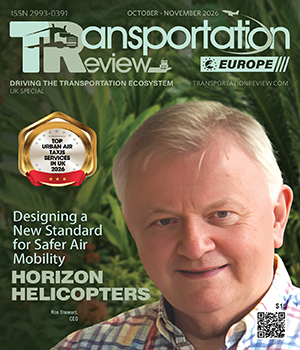
Horizon Helicopters
Designing a New Standard for Safer Air Mobility
As urban air taxi services move closer to becoming a practical transportation option, one challenge remains at the center of industry discussions: How can vertical flight become safer, more reliable, and easier to operate? The ability to take off and land vertically has always given helicopters a unique advantage. However, operating a helicopter requires significant skill, and pilot workload has remained one of the biggest challenges affecting wider adoption. For urban air taxi services, where passenger confidence and operational consistency will determine long-term acceptance, safety cannot be an afterthought. Horizon Helicopters Ltd. is addressing this challenge through the development of the Autocopter, an advanced aircraft designed around one central principle: making vertical flight safer to operate. Originally conceived to let private pilots operate a helicopter-type aircraft with a much higher level of safety and lower workload, the Autocopter applies the same architecture to air-taxi operations. The aircraft combines vertical takeoff and landing capability with high-speed forward flight while introducing advanced redundancy, automation, and monitoring systems designed to reduce pilot workload and improve operational confidence. Unlike traditional helicopter designs, which often place significant responsibility on pilot skill and experience, Horizon’s approach focuses on creating an aircraft that can support pilots with different levels of expertise. The company believes that the future of vertical flight depends not only on speed and efficiency but also on making aircraft easier and safer to operate. “The aircraft was designed with the intent to create an aircraft that private pilots could fly with real safety,” says Ron Stewart, CEO of Horizon Helicopters Ltd.
Airport Management
Aviation Management International
Engineering Journeys, Not Just Airports
Dr. DI. Viorel Gruenwald, CEO
Every air passenger journey relies on systems that work seamlessly behind the scenes. Aviation Management International (AMI), headquartered in Romania, has built its reputation on making that flow possible. The company delivers specialised IT consultancy, system integration, and tailored hardware and software for civil aviation and border security, ensuring that critical infrastructure keeps pace with the demands of modern travel. Its portfolio spans passenger processing, baggage reconciliation, flight information systems, identity management, airport command centers and advanced border control technologies. These digital solutions streamline operations and enhance efficiency, helping airports and governments manage complexity and scale. What differentiates AMI is its philosophy. The company positions itself as a long-term, trusted partner rather than a one-time vendor. Its 26-member team brings expertise from aviation, airports, airlines, air traffic control, and government, enabling the design of systems that are not generic but finely tuned to each client’s operational and strategic priorities. The focus always returns to the traveller, treating passenger flow and experience as a priority rather than a metric. That commitment extends well beyond deployment. AMI provides complete lifecycle services, ensuring that systems evolve alongside client needs. The company adheres to EU standards and GDPR compliance, giving clients peace of mind that their solutions are secure, resilient, and risk-averse. For small and mid-sized airports in particular, AMI’s approach offers a path to affordable and sustainable modernisation. “At AMI, we combine deep industry knowledge, customisation, and after-sales commitment to deliver seamless, passenger focused airport solutions that build trust, reduce risk, and shape aviation’s future,” says Dr. DI. Viorel Gruenwald, CEO, AMI.

Railway Management System

Focus Sensors
Advancing Rail Safety through Intelligent Fibre Sensing
Dr Ed Austin, Co-Founder and Managing Director
Precise monitoring of assets such as tracks and wheels is essential to rail safety. Focus Sensors leverages the power of fibre-optic networks and sensors to monitor and deliver continuous insights into track stability, wheel health, early warning signs of failure and even the presence of intruders. The idea was born from a simple conversation between two friends, Dr Ed Austin and Dr Weizhong Zhao, in a pub in Winchester. They wondered why the optical fibres already installed for communications couldn’t be used as sensors to improve the safety and efficiency of rail infrastructure. This thought sparked two years of experimentation in a drafty garage, culminating in the creation of Indus, a distributed sensing system that provides rail operators with continuous visibility into track and infrastructure health. They later built the Indus Platform, a cloud-based system that turns data from Indus into real-time insights that operators can act upon. “Our unique, patented, fibre-monitoring system opens the door to vast and continuous railway monitoring, solving problems for our customers,” says Dr Austin, co-founder and managing director. Indus combines fibre optic movement sensing (FOMS) and acoustic sensing (FOAS) to interpret how the track, its support structure and passing trains behave in real-time. By comparing how the track responds over time, the system detects subtle changes that would otherwise go unnoticed. Focus Sensors’ technology has been deployed in multiple locations around the world. It works with major operators, including Network Rail, ProRail and ADIF. Each Indus station monitors up to 80 kilometres of track with one-metre resolution. Installation is typically completed within four hours without requiring access to the track. Its collaboration with Network Rail High Speed on the HS1 route demonstrated how optical signals could be translated into actionable insight. Over the course of six months, more than 11 million measurements were taken along 38 kilometres of track. It revealed issues in switch and crossing components by showing abnormal vibration patterns and elevated track instability at the failing component. Eventual successful repair reduced the instability, as expected. Furthermore, Indus uncovered areas of increased track instability 50m from the faulty component, providing a probable reason for the failure.
Transportation Management

Warehouse automation and supply chain flexibility - now you can have both
Ronald Poort, Chief Commercial Officer, DSV [CPH:DSV]
Fleet Management

Innovation is the Way to Process Optimization
Iwona Czapura-Zelik, Regional Director, Fresh Logistics Polska, Raben Group
Airport Experience

Digitalisation and Responsibility: Innovations for Animal Welfare, Sustainability and Integrity in the Meat Supply Chain
Dr Veronika Weber, Chief Sustainability Officer, Vion Food Group
Airport Experience

We Don't Just Move Freight, we Move Futures
Ruud Mars, Director of Business Development Transport, Bleckmann
Airport Experience

The Human Side of Fleet Leadership
Calvin Vannett, Transportation Manager, Savage

IN MY OPINION
Fleet Management
Building Momentum in Logistics Through Collaboration and Innovation
Victor Aguayo, Head of Regional Implementation Center North-West Europe, Rhenus Logistics
LAST WORD
Railway Management System
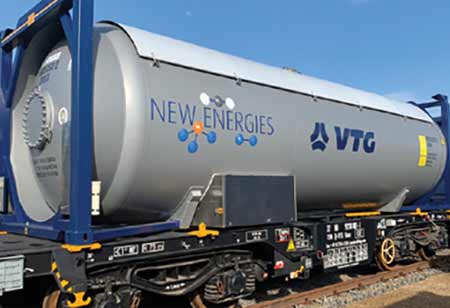
The Future is on the Rails
Stefan Siegemund, Business Development Manager New Energies, VTG
IN FOCUS
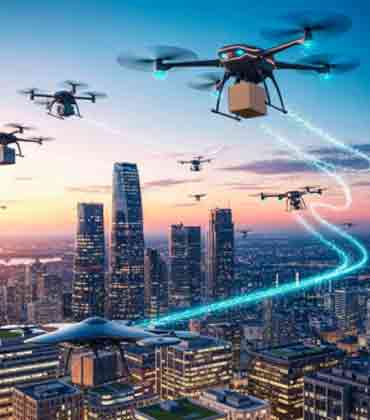
Urban Air Taxi Services in Europe: Next Generation of Mobility
European urban air taxi services combine electric aircraft, intelligent infrastructure, digital mobility, safety, and sustainable transportation.

From Storage to Strategy in Warehouse and Distribution
A warehouse is no longer simply a place where goods wait before moving to their next destination. It has become an important part of how companies manage inventory, respond to demand and deliver products to customers.
EDITORIAL
From Urban Air Taxis to Energy Logistics
Urban mobility is entering a period of technological change as cities explore transport models that can complement conventional road and rail networks. This issue of Transportation Review Europe examines how advances in vertical flight, digital logistics and sustainable freight infrastructure are shaping the next generation of transport.
Our cover story recognises Horizon Helicopters as the Top Urban Air Taxis Services in UK 2026. Its Autocopter is designed around safety, operational reliability and reduced pilot workload, combining vertical take-off and landing with high-speed forward flight. A triplex architecture featuring three engines, three electromechanical hybrid drives and three fly-by-wire controllers provides multiple layers of redundancy. Autonomous and semi-autonomous capabilities, singlepilot IFR capability and a Health and Usage Monitoring System further support the company’s focus on safer vertical mobility. With an intended range of approximately 1,000 miles and a cruise speed of around 200 mph, the aircraft is being developed for urban air taxi, personal transport, utility and medical applications.
The issue also highlights how transport innovation extends beyond aviation. Victor Aguayo, Director IT - Warehousing Solutions at Rhenus Logistics, discusses how agile and lean principles can strengthen collaboration between IT and operations. His approach uses structured development cycles, root-cause analysis and citizen development to improve responsiveness. One initiative reduced the average delivery time for medium-sized customer requests from six to eight weeks to two to four weeks.
Stefan Siegemund, Business Developer New Energies at VTG, examines rail’s role in the emerging energy economy. His perspective highlights the transport of LNG, hydrogen, ammonia and captured CO2 by rail, supported by specialised assets and existing infrastructure. VTG’s experience with more than 1,000 ammonia wagons demonstrates how rail can contribute to future energy logistics.
Together, these perspectives illustrate a transport sector expanding beyond established boundaries. Whether through safer vertical flight, digitally enabled warehousing or rail-based energy logistics, innovation is increasingly shaped by the ability to connect technology, infrastructure, safety and practical transport needs.
